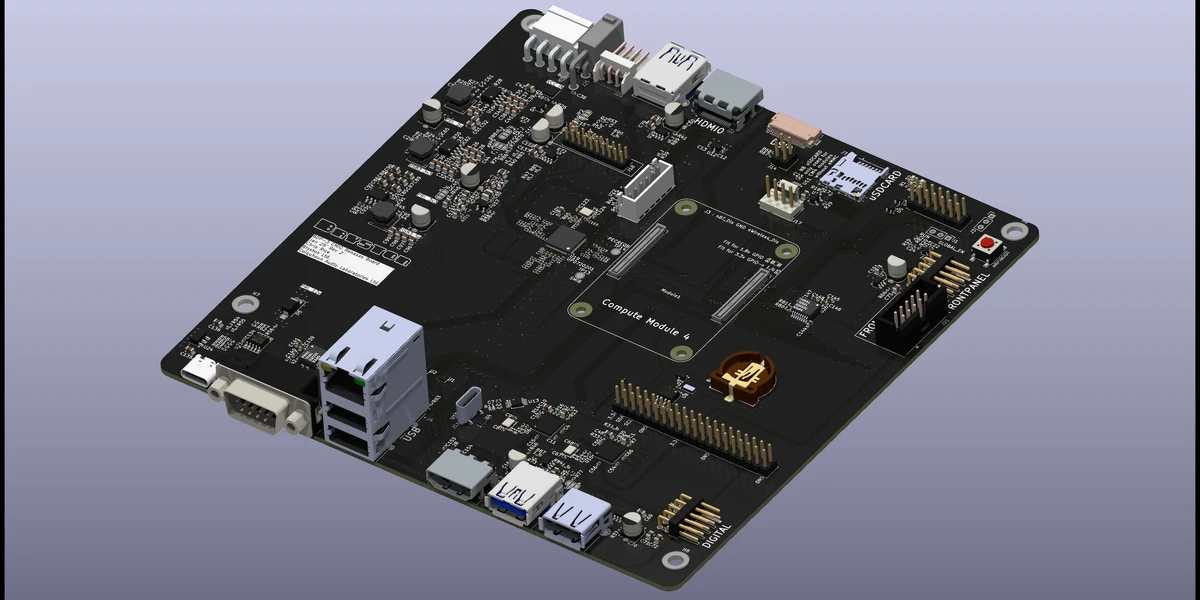
CM4 IO Board - Bryston BDP-3 Music Player
A mechanically compatible Raspberry Pi Compute Module 4 carrier board designed for the Bryston BDP-3 digital player platform.
Overview
The BDP-3 CM4 IO board was a custom Raspberry Pi Compute Module 4 carrier board designed for the Bryston BDP-3 digital player platform.
The board was created as a mechanically compatible replacement for an existing internal board. It needed to fit in the same location, use the existing chassis constraints, and preserve the product features that were still required, while modernizing the platform around the Raspberry Pi Compute Module 4.
The project started from the official Raspberry Pi CM4 IO board reference design, but the final board was adapted for the specific electrical, mechanical, manufacturing, and product requirements of the BDP-3.
Project Goals
The main goal of this project was to modernize the BDP-3 hardware platform around the Raspberry Pi Compute Module 4 while avoiding major changes to the surrounding product.
The replacement board needed to:
- Fit within the existing mechanical envelope
- Preserve the required mounting and connector constraints
- Maintain compatibility with the existing chassis and internal cabling
- Support the product features that were still actively used
- Integrate the CM4 into the BDP-3 product architecture
- Work within practical manufacturing and procurement constraints
Some legacy features from the previous board were intentionally de-scoped due to time and project constraints. VGA was not included, as the original board’s VGA output was not used in the product. The 3.5 mm stereo output was also omitted, since the BDP-3 audio output path used a USB-to-SPDIF board with dual clocks. The board also did not include a native internal SATA connection; instead, the product used a USB-to-SATA adapter, supported by an internal USB 3 connection.
Hardware Design
The design was based on the official Raspberry Pi CM4 IO board, but was modified into a product-specific carrier board for the BDP-3.
The board integrated the Compute Module 4 with the interfaces required by the product, including USB, Ethernet, HDMI, storage support, front-panel connections, service/debug access, RTC/control circuitry, power distribution, and internal expansion connections.
Rather than using the reference design directly, I adapted the relevant portions of the CM4 IO architecture to match the needs of the existing BDP-3 hardware platform. This required deciding which parts of the reference design were appropriate to keep, which needed to be modified, and which product-specific features had to be added, preserved, replaced, or intentionally left out.
Mechanical and Product Constraints
A major constraint of the project was that the new board had to fit into the existing BDP-3 chassis in place of the board it replaced.
This meant the design had to respect the existing mechanical envelope, mounting locations, connector placement, cable routing, and chassis clearances. The board needed to modernize the internal compute platform without forcing a redesign of the enclosure or surrounding hardware.
Although the board was not a perfect 1:1 feature replacement, it preserved the product functionality that was required for the updated BDP-3 platform. Where legacy interfaces were no longer required or practical to include, alternative approaches were used to maintain the intended product behaviour.
Manufacturing and Procurement
The board also had to be designed with practical manufacturing constraints in mind.
Where possible, components were selected from parts available through JLCPCB to simplify procurement and assembly. This required balancing preferred component choices against availability, package options, assembly support, and the realities of producing a board through a contract PCB assembly service.
This added a real-world supply-chain constraint to the design process and helped keep the board practical to build, not just functional on paper.
Mentorship and Team Development
I also used this project as an opportunity to mentor another employee who had a bachelor’s degree in computer engineering and was working in the service department.
The goal was to help move them toward board design work by having them develop a related USB 3 hub sub-board for the project. I provided guidance and mentorship as they began working on the design.
That sub-board was not completed due to staffing changes before their portion of the project was finished, but the effort was still an important part of the project from a mentorship and team-development perspective.
My Role
I independently designed the main CM4 IO board, starting from the official Raspberry Pi CM4 IO reference design and adapting it into a mechanically compatible replacement for the existing BDP-3 internal board.
My responsibilities included schematic design, component selection, connector planning, product feature compatibility, mechanical fit considerations, power and control integration, design-for-manufacturing decisions, and mentoring another employee on a related USB 3 hub sub-board design.
The project required working across embedded hardware, product integration, mechanical constraints, manufacturing constraints, supply-chain constraints, and long-term product sustainment.
Skills Demonstrated
- Raspberry Pi Compute Module 4 carrier board design
- Vendor reference design adaptation
- Custom PCB design
- Embedded hardware integration
- Product sustainment engineering
- Mechanically compatible replacement board design
- Legacy hardware feature evaluation
- USB 3 integration
- USB-to-SATA product integration
- Digital audio product architecture
- Connector and internal cabling planning
- Power distribution and control integration
- JLCPCB-oriented component selection
- Design for manufacturing
- Supply-chain-aware hardware design
- Mentorship and technical training
- Commercial audio product development
- Embedded Linux hardware platform support
Summary
The BDP-3 CM4 IO board was a product-specific Compute Module 4 carrier board designed to modernize an existing commercial audio platform while preserving compatibility with the surrounding product.
By adapting the official Raspberry Pi CM4 IO reference design into a mechanically compatible, manufacturable replacement board, the project balanced modernization with the practical constraints of an existing product. It also involved evaluating which legacy features were still required, replacing some functions with practical alternatives, and mentoring another employee as they began moving into board design work.
This project demonstrates my ability to take a proven reference design and turn it into a constrained, production-oriented embedded hardware platform while accounting for electrical design, mechanical fit, manufacturability, procurement, product compatibility, and team development.